

Fast Fashion as a Tragedy of the Commons: Why Our Shopping Habits Matter
April 12, 2023
How Often Should I Buy New Clothes? Experts Explain
July 22, 2023
Urban Outfitters markets itself as trendy, creative, and conscious—but its actual practices are far less clear. If you’ve been wondering “is Urban Outfitters fast fashion” because the brand’s sustainability claims feel confusing or inconsistent, you’re not alone. In this guide, we’ll break down what Urban Outfitters is really doing behind the scenes, in terms of ethics, materials, transparency, and more. Let’s dive in!
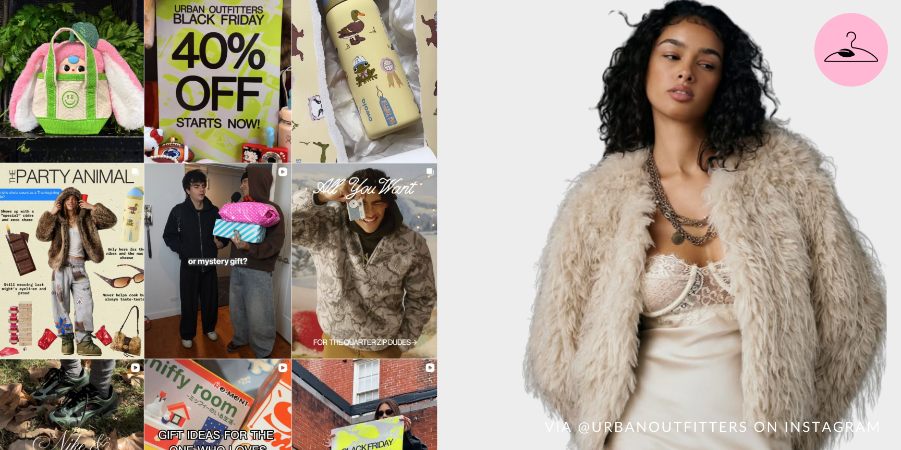
Is Urban Outfitters Fast Fashion?
Urban Outfitters provides very little verified information about its sourcing, worker conditions, or environmental footprint, leaving consumers with almost no insight into how its products are made. When this level of opacity is combined with trend-driven releases and minimal sustainability commitments, Urban Outfitters clearly fits the core characteristics of fast fashion.
| Indicator | Evidence | Assessment |
|---|---|---|
| Transparency | Extremely low scores on major transparency indexes | ❌ Very Low Transparency |
| Labor & Ethics | History of labor violations and unpaid supplier orders | ❌ Poor Labor Practices |
| Materials & Environment | Heavy use of synthetics; past toxic materials findings | ❌ High Environmental Impact |
| Production Model | Trend-driven, high-volume manufacturing | ❌ Fast Fashion Production |
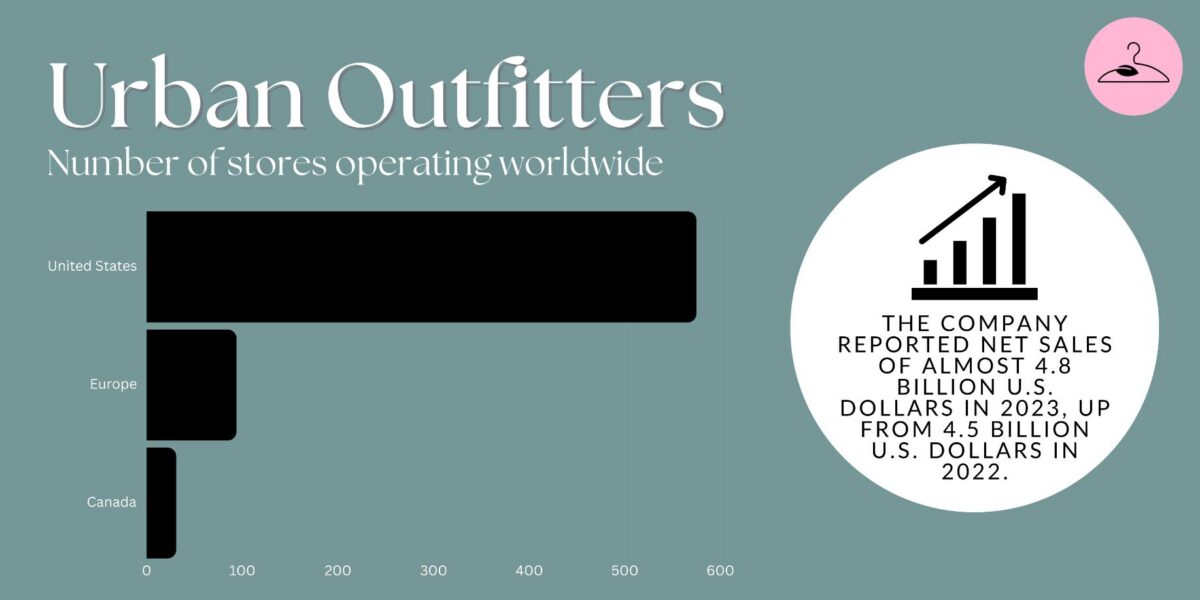
Urban Outfitters’s Lack of Transparency
Urban Outfitters received a rating of 3/100 on the Good On You index – one of the lowest scores that we have seen, even among ultra fast fashion brands. While URBN now publishes biannual Impact Reports, the brand still offers limited public disclosure, and most sustainability information remains fragmented or difficult for consumers to verify.
What’s more, Urban Outfitters, along with brands such as Versace, Miu Miu, Aritzia, and Prada, received a score of 11-20% on the Fashion Transparency Index in 2022. This is a trustworthy rating that everyday consumers can rely on, as it assesses 250 of the world’s largest fashion companies on their openness regarding labor conditions, environmental impact, and supply chain ethics.
A score this low reveals that Urban Outfitters shares virtually no information about where its clothing comes from, who produces it, or how its operations affect workers and customers. For a company with a 4.17% market share in 2025, this level of opacity is particularly troubling.
Behind the Audits: What Urban Outfitters Still Won’t Share
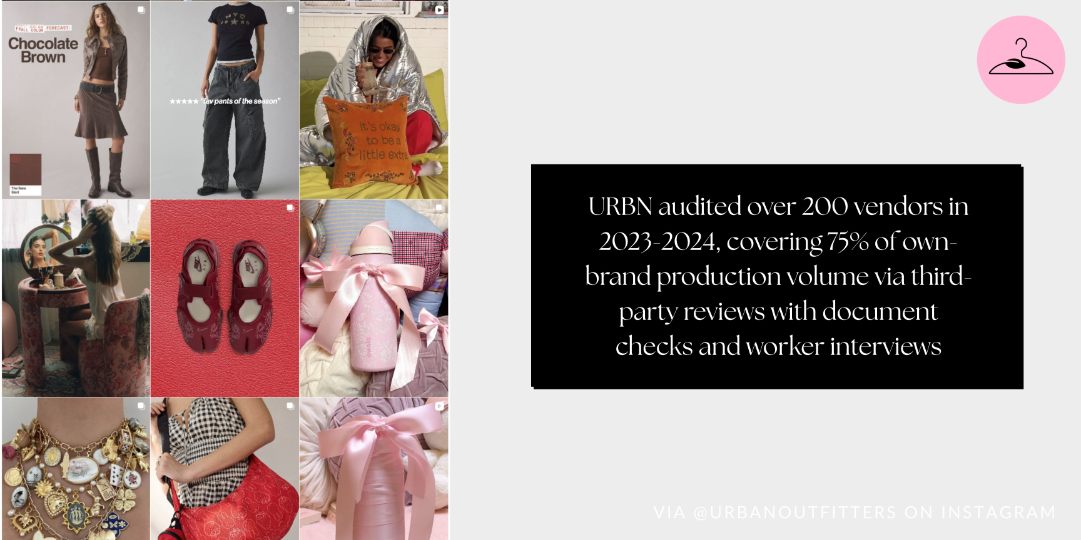
URBN reports that it audited 200+ vendors in 2023–2024 — covering around 75% of its own-brand production — and launched a supplier risk-scoring system supported by third-party assessments and worker interviews. Yet the company does not publish audit findings, violation rates, corrective actions, or factory-level wage data, making it impossible to assess real working conditions.
Supply-chain mapping has advanced slightly, with Tier 1 traceability pilots (such as Free People’s Hot Shot Mini) and a stated goal of mapping Tier 2 suppliers by 2025. However, Urban Outfitters still does not disclose full supplier lists, subcontractors, production volumes, or wage benchmarks, leaving major gaps in transparency.
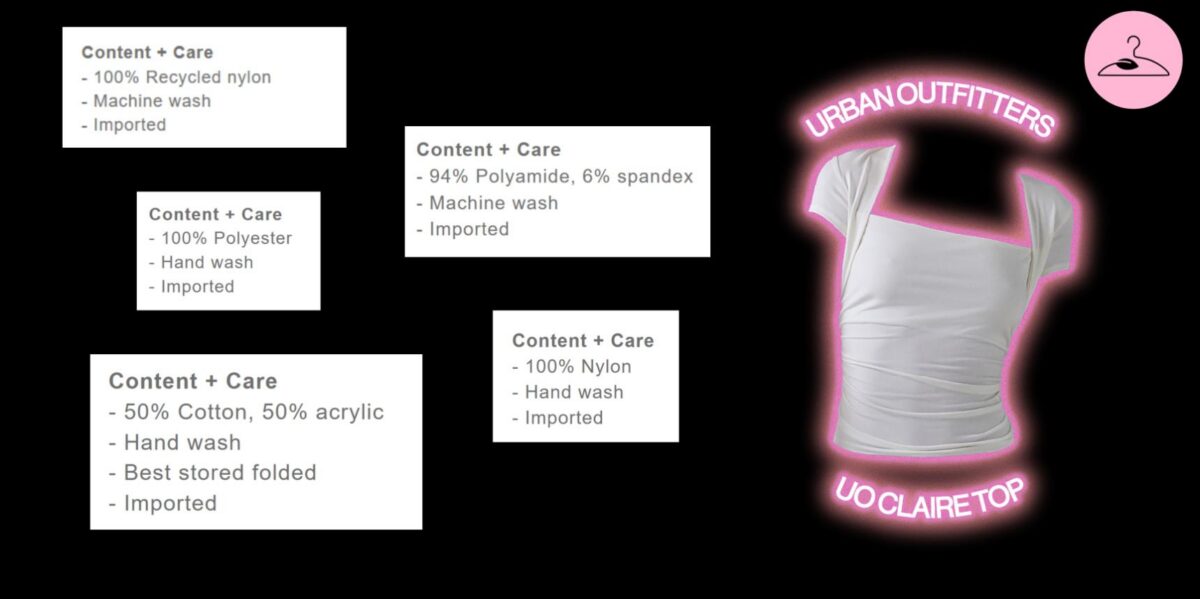
UO’s Fabrics And Environmental Impact
While the brand uses some eco-friendly materials, including recycled fabrics, there is no evidence it actually does anything to minimize textile waste.
Circularity… or Just a Convenient Talking Point?
Urban Outfitters likes to position itself as a brand that dabbles in sustainability. It mentions using some recycled fabrics, proudly shares that it has “recirculated” over 7 million garments, and showcases secondhand flannels and sweaters as proof of its long-standing commitment to circular fashion. They even partner with organizations like FABSCRAP to repurpose scraps from sample rooms and pattern-making studios, something its marketing team certainly doesn’t forget to spotlight.
But these initiatives represent a tiny fraction of the brand’s total output. URBN’s 2023–2024 Impact Report shows progress, such as repairing 1.4 million Nuuly rental garments and upcycling 121,600 deadstock items, yet without total production numbers, it’s impossible to know how much waste these efforts actually reduce.
| Area | Reported Progress | Missing Transparency |
|---|---|---|
| Fibers & Materials | • 50%+ of EU fibers “responsible” (recycled, Lenzing, Better Cotton) • 75% cotton alternatively sourced • 65% less water • 6% less carbon at fiber stage | • Total % of synthetics in UO’s assortment • Global production volumes |
| Denim Program | • BDG denim contains 20% recycled content across 52 styles • Ozone/laser finishing used • Trialed 100% recycled RCO100 cloth | • No roadmap for scaling recycled denim • No chemical elimination plan |
| Corporate Initiatives | • 474 tons virgin plastic eliminated (URBN-wide) • 84% EU renewable energy | • No UO-specific Scope 3 emissions • No water reduction targets |
Selective Commitments That Don’t Address the Bigger Problem
Urban Outfitters highlights several sustainability wins: some of which are meaningful, but none of which address the core issue: the brand’s massive production output. For example, UO reports that over 50% of its EU apparel and homeware fibers now come from “responsible” sources such as recycled materials, Lenzing fibers, and Better Cotton.
According to URBN, switching to these fibers reduced the water footprint by 65% and carbon emissions by 6% at the fiber stage, with 75% of cotton alternatively sourced. Their BDG denim line has also seen improvements, with 20% recycled content across 52 styles, low-impact ozone/laser finishing, and even a trial of RCO100, a fully recycled denim cloth.
The Fabric Data Urban Outfitters Refuses to Share
On a broader level, UO benefits from URBN’s corporate initiatives, like eliminating 474 tons of virgin plastic and sourcing 84% renewable energy in the EU. These are promising signals for the parent company. But here’s the issue: none of this comes with brand-specific transparency.
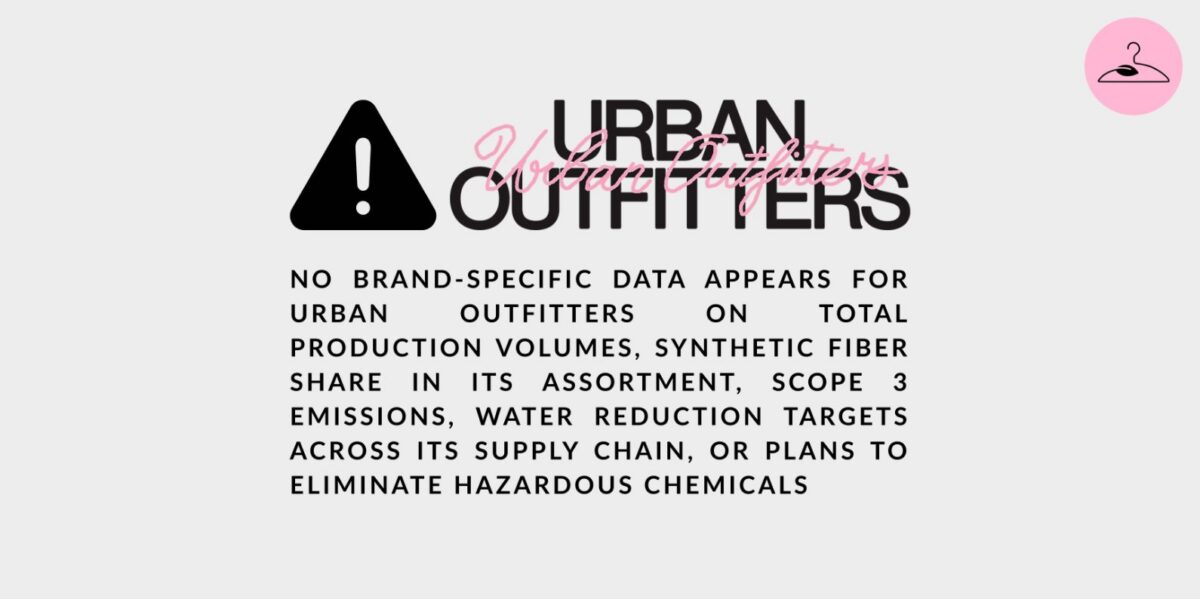
Urban Outfitters still provides no data on:
- Total production volumes,
- Synthetic fiber share in its overall assortment,
- Scope 3 emissions,
- Water reduction targets across its supply chain, or
- Plans to eliminate hazardous chemicals.
In other words, UO spotlights its “responsible fibers” while keeping the biggest questions unanswered. Meanwhile, the brand continues to rely heavily on popular synthetic fabrics, such as acrylic, polyester, nylon, the usual fast fashion trio that simply don’t fit into a circular system. These materials are cheap, non-biodegradable, and nearly impossible to recycle, meaning they directly contradict the brand’s narrative of sustainability.
Urban Outfitters Clothing Was Found to Contain Heavy Metals
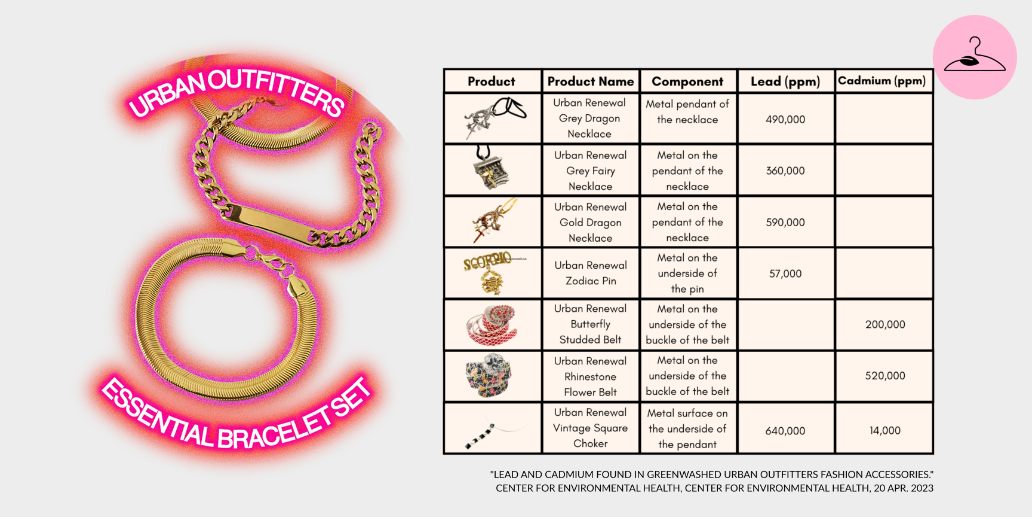
Perhaps the most troubling environmental (and health) revelation comes from the Center for Environmental Health (CEH). Their investigation found dangerously high levels of lead and cadmium in Urban Outfitters’ “Urban Renewal” collection. For context:
- California’s legal limit for lead in accessories is 60,000 ppm.
- One Urban Outfitters necklace contained over 590,000 ppm.
After CEH published its findings and hundreds of consumers signed a petition, Urban Outfitters removed the contaminated jewelry from its website, which is a positive step, but not a complete solution. CEH is still urging the brand to publicly commit to basic product-safety standards to ensure this doesn’t happen again.
Where Does Urban Outfitters Make Their Clothes?
Urban Outfitters relies heavily on low-cost manufacturing hubs such as Vietnam, Turkey, Cambodia, and China. Yet the brand provides no meaningful evidence that workers in these factories receive fair wages or have safe working conditions.
Its only public stance is a broad Modern Slavery Act statement asking suppliers to ‘conduct business in a lawful, ethical, and responsible manner.’ But without third-party audits or transparent reporting, this reads more like corporate décor than real accountability, reassuring on paper, but revealing nothing about what actually happens behind the scenes.
And the reputation that follows UO reflects this opacity. In 2020, a public labor watchdog report named Urban Outfitters among the “top violators” of labor rights, listed alongside fast fashion giants like Forever 21, Harley Davidson, and Lulu’s. The brand’s history supports this criticism.
Violating Labor Rights
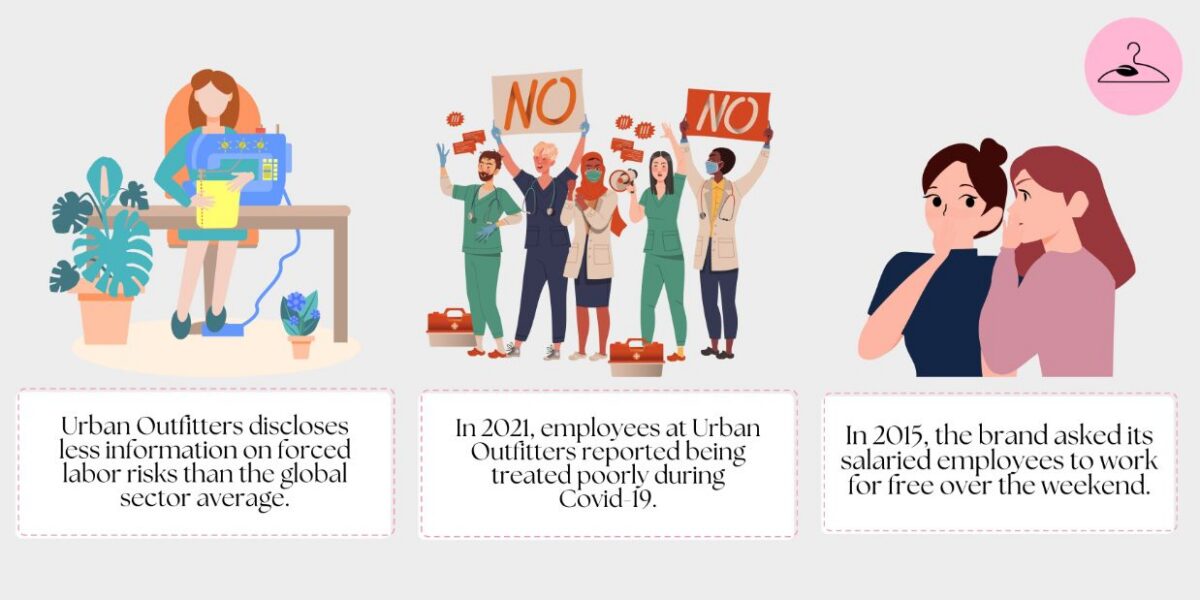
Urban Outfitters’ policy states that it does not sell products made with forced-labor cotton from Uzbekistan. However, in 2014, the brand received the lowest score on a survey regarding this matter.
Just a year later, in 2015, it was involved in a labor scandal for illegal overtime practices. Employees were reportedly pressured into working extra hours without pay, disguised as a “voluntary training day.” The incident wasn’t an isolated mistake; it exposed real issues of labor exploitation at home, not just overseas.
UO’s Cultural Fraud and Controversies
Urban Outfitters describes itself as “dedicated to inspiring customers through a unique combination of product, creativity, and cultural understanding”. Yet, there isn’t much proof to back up this optimistic mission. Here’s why:
The Navajo Lawsuit Against Urban Outfitters
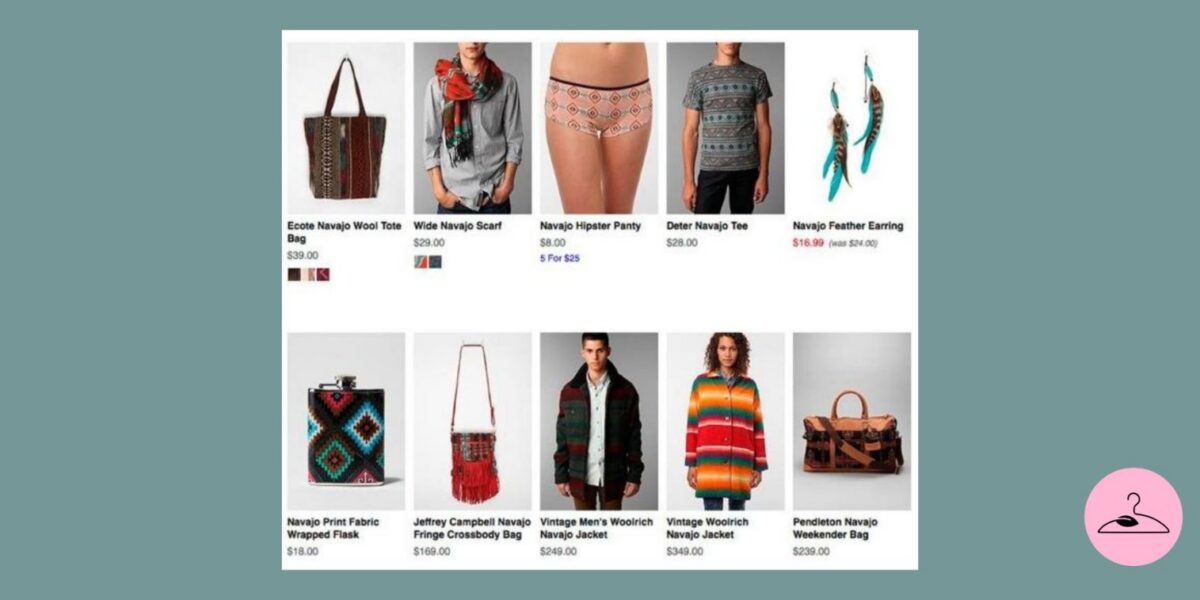
One of the most striking examples of cultural insensitivity came when Urban Outfitters released a line of products mimicking Navajo cultural motifs, including underwear, flasks, and headbands. These cheap reproductions of a living culture were stripped of meaning and instead, were sold as aesthetic gimmicks.
The misuse didn’t go unnoticed. The Navajo Nation had already protected its name legally as early as 1943, yet Urban Outfitters had used “Navajo” across its merchandise since at least 2001. In 2012, the tribe filed a lawsuit accusing the brand of trademark violation and cultural exploitation, citing a collection of more than 20 Navajo-inspired products.
The case was quietly resolved in 2016 with an undisclosed agreement. A UO spokesperson called the outcome a “mutual resolution,” even suggesting potential collaboration, a statement that only highlighted how disconnected the brand was from the harm it caused.
A Pattern of Cultural Insensitivity
Unfortunately, the Navajo incident wasn’t an anomaly. Over the years, Urban Outfitters has repeatedly released items steeped in cultural and political insensitivity. Among them:
- Palestinian-style keffiyehs marketed as “anti-war woven scarves”
- Shirts resembling Holocaust-era prison uniforms
- A duvet cover featuring the Hindu deity Ganesh
- A 2008 tapestry eerily reminiscent of Holocaust imagery
- Accessories similar to badges Jews were forced to wear during the Nazi regime
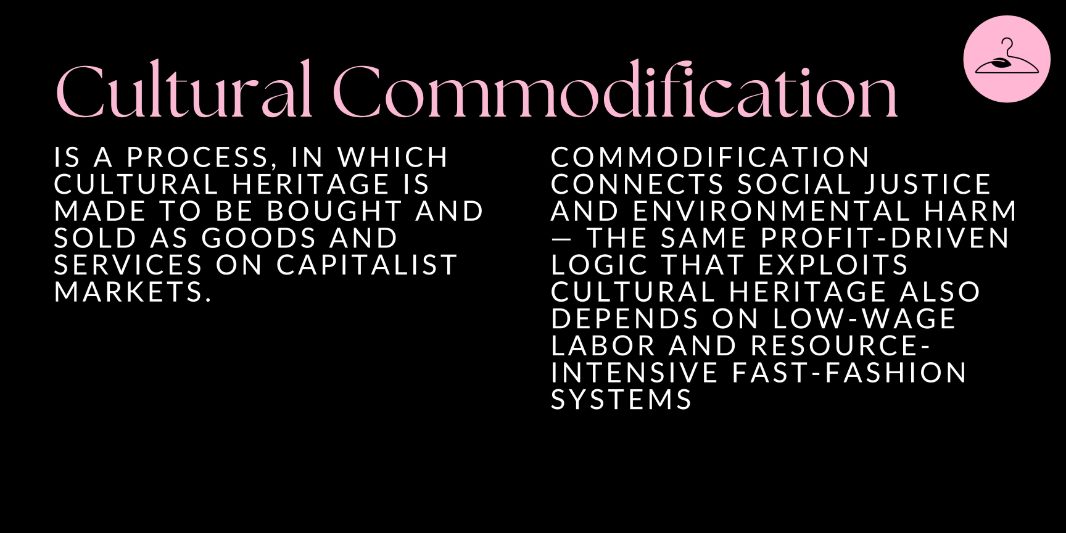
Each scandal followed the same pattern: public outrage, hurried removal, and no meaningful accountability. And when these incidents accumulate, they paint a clear picture: Urban Outfitters doesn’t just make mistakes. The brand gravitates toward culturally charged aesthetics without regard for history, identity, or respect, repeatedly profiting from motifs that aren’t its own, turning sacred symbols and painful histories into edgy products for a quick trend cycle.
The #PayUp Petition
Before the pandemic, Urban Outfitters placed orders with its suppliers, then refused to pay for them once the crisis hit. What followed was devastating: factories across Bangladesh, Cambodia, and Myanmar had already shouldered high upfront production costs, operating on razor-thin margins. When brands like UO walked away, these suppliers had nothing to fall back on.
Urban Outfitters was not alone in this. Retail giants such as Arcadia Group, Walmart, and Mothercare also withheld payments, collectively stripping overseas factories of more than $16 billion in revenue. As a result, millions of garment workers were laid off, left unpaid, or abandoned entirely as factories shuttered under the financial strain.
What The #PayUp Campaign Achieved
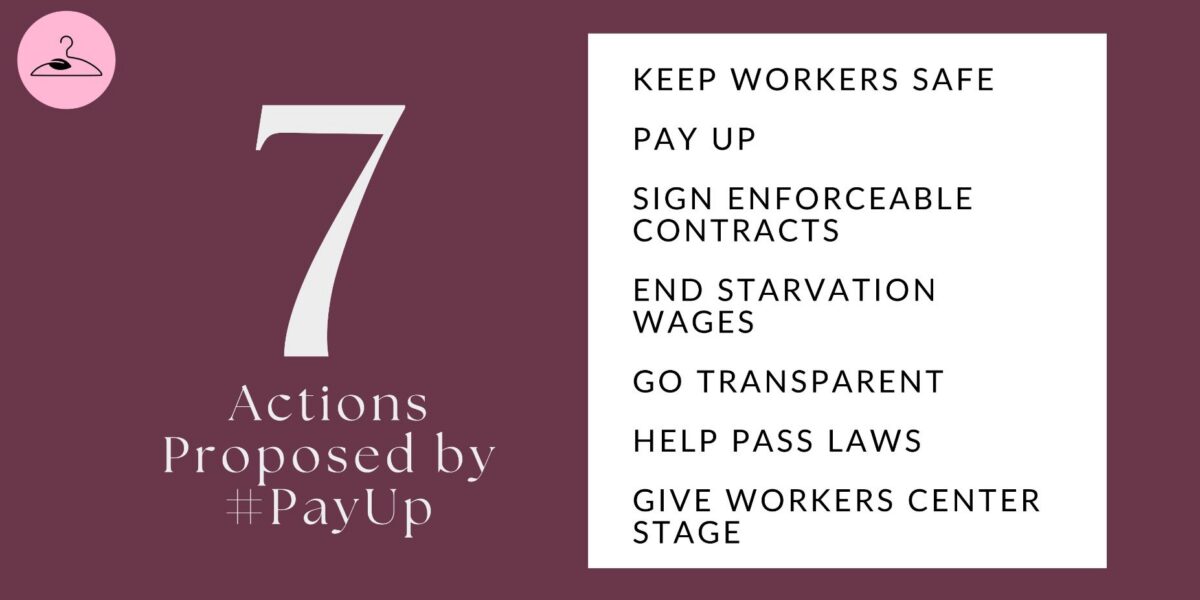
To combat this, Remake launched a campaign, #PayUp, to protect labor rights, establish enforceable contracts, and put an end to drastic power imbalances in the industry. The movement gained enormous traction and pressured some retailers into paying what they owed. But the success was only partial. Even after joining the #PayUp initiative, Urban Outfitters reportedly canceled additional orders, citing the Covid-19 crisis, and even requested discounts on shipments that had already been completed.
The brand’s despicable actions in the middle of a worldwide crisis put the lives of garment workers at risk as they tackled food and housing insecurity. Acts like these reveal the deep ethical contradictions at the core of fast fashion and run directly counter to any claim of sustainability or social responsibility.
What Age Group Does Urban Outfitters Target?
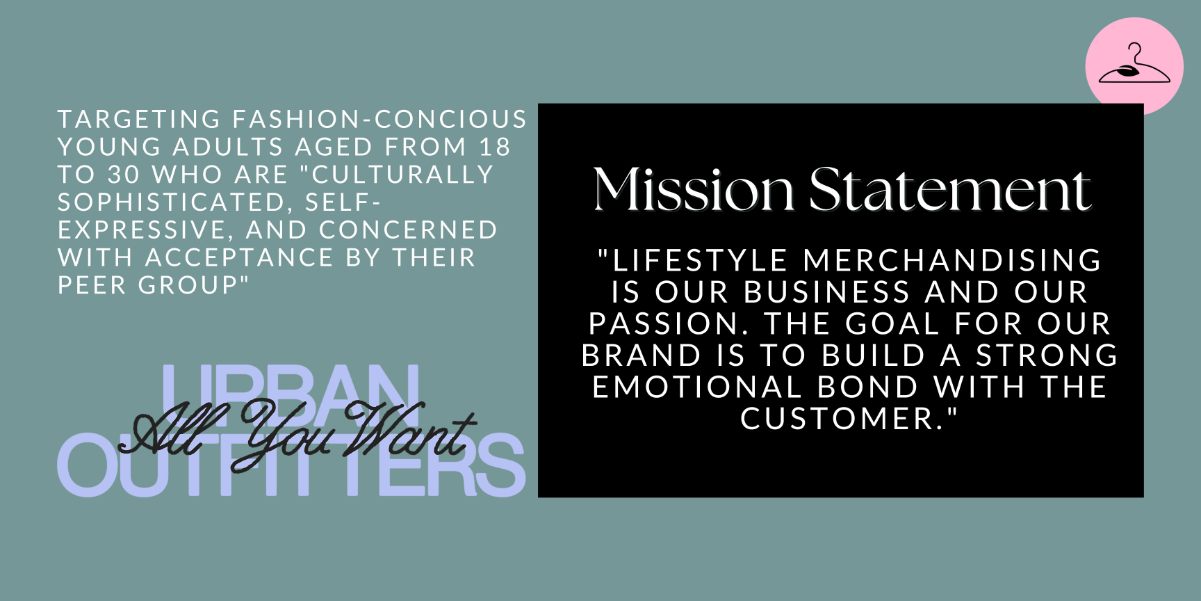
Urban Outfitters primarily targets shoppers aged 18–24, the core demographic behind fast fashion trends. While the brand also sells home décor, beauty, and lifestyle products, its overall aesthetic is built around viral, trend-driven styles that appeal to younger consumers seeking constant newness, social media–influenced looks, and affordable wardrobe updates.
Whether it’s early-2000s nostalgia or TikTok-driven “clean girl” looks, Urban Outfitters consistently follows micro-trends rather than creating long-lasting, timeless designs. This constant trend turnover is a hallmark of fast fashion.
Mid-Range, But Still Fast Fashion? UO vs Aritzia
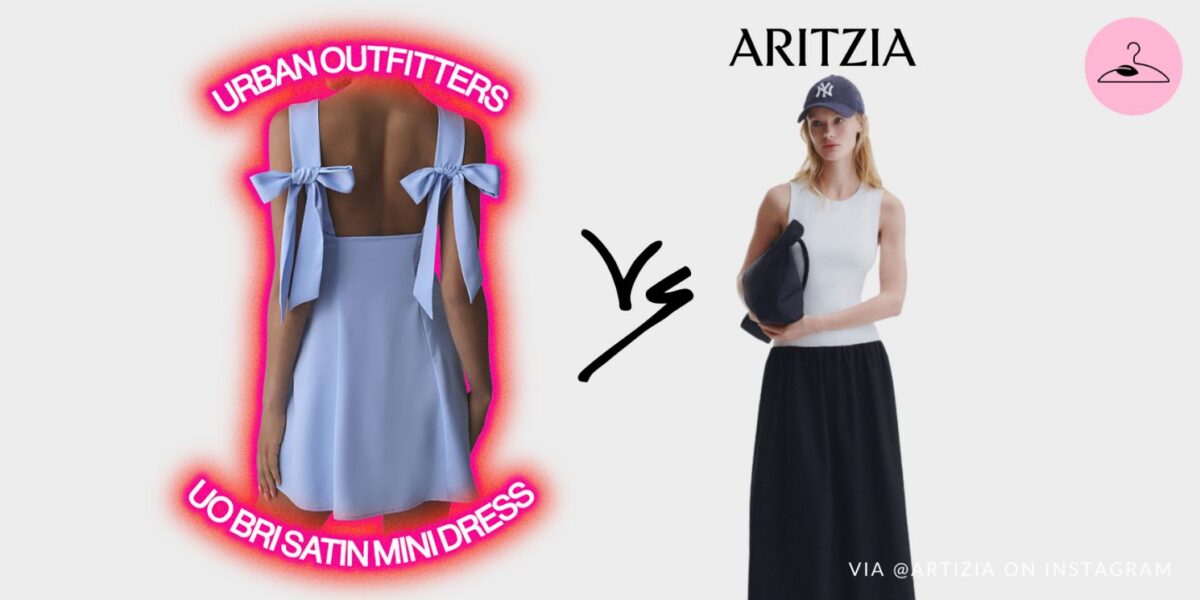
Urban Outfitters often charges noticeably more than ultra-fast-fashion retailers: a simple graphic tee can run up to $50, compared to the typical $25–$30 elsewhere. But a higher price tag doesn’t mean better quality or ethical production.
Just like Aritzia, Urban Outfitters uses pricing and aesthetics to position itself as more “premium” than typical fast fashion. As a mid-range fast fashion brand, Aritzia, leans into a minimalist, elevated aesthetic, while Urban Outfitters leans into youth-driven trends, but both ultimately rely on low-cost materials and high-volume manufacturing despite their moderately upscale branding. In reality, the higher prices reflect branding, not sustainable or higher-quality practices.
Why Fast Fashion is Problematic
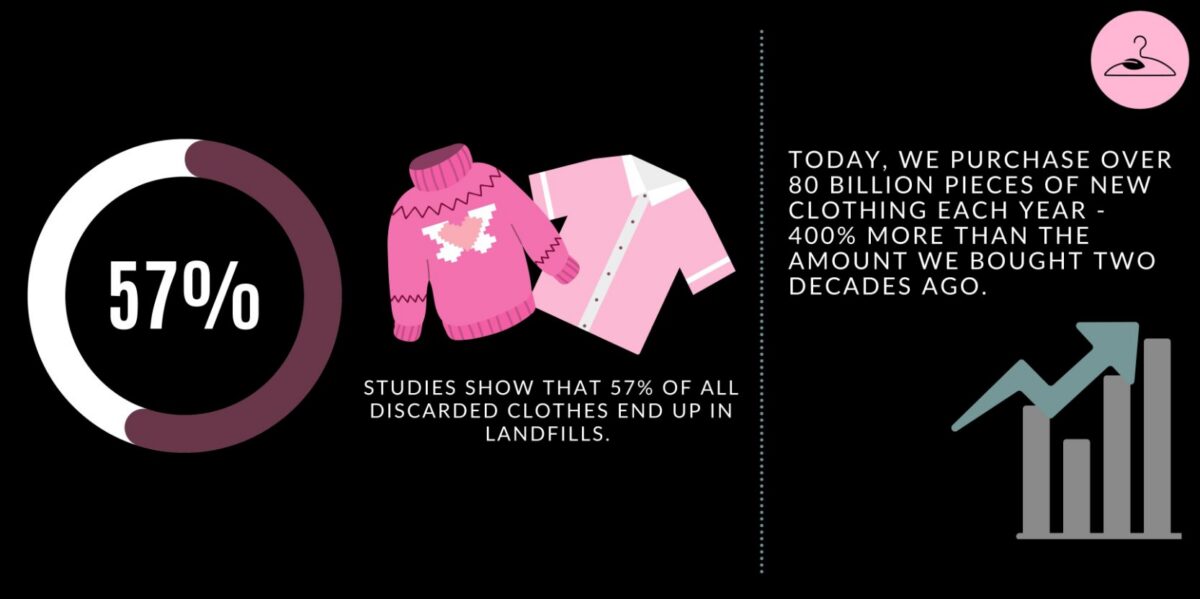
“Fast fashion” is a new phrase used to refer to retailers that churn out low-cost clothes cheaply and efficiently, with some brands launching 52 different collections a year. This means that consumers can access new clothes every week, which burdens the planet with more and more textile waste.
Brands are now producing clothes much cheaper than before, molding fast fashion into an environmental and social disaster. Employing cheap labor overseas, overusing natural resources, and creating artificial demand for clothes, they maximize profit while sacrificing the well-being of people and the planet.
Is Urban Outfitters Ethical ? The Final Verdict
Urban Outfitters is a brand with lots of underlying issues that consumers simply choose to ignore, or even worse, embrace to seek novelty, consume their pieces, and turn a blind eye on the obvious malpractices. Is it a fast fashion brand? Absolutely, however, the issues go so much deeper than the label. The blatant cultural commodification, lack of transparency, false ‘green’ claims, and overproduction make it one of the most controversial brands out there on the market.
There aren’t many good things to say about Urban Outfitters, except that they use eco-friendly packaging and semi-natural fabrics. The latter include semi-synthetic or regenerated cellulosic viscose, cupro, or modal. However, overall, there are no positive aspects to mention.

Frequently Asked Questions
Fast fashion brands like Urban Outfitters raise major ethical concerns, including poor transparency, potential low-wage or unsafe labor conditions, high production volumes that create textile waste, and reliance on cheap synthetics that contribute to pollution. Their trend-driven model promotes overconsumption while avoiding strong commitments to fair wages, environmental responsibility, or long-term sustainability.
Compared to truly sustainable brands, Urban Outfitters offers little visibility into its supply chain. While it highlights limited recycled materials and small circularity efforts, it publishes no supplier lists, audits, wage data, or Scope 3 emissions. Sustainable brands typically disclose sourcing, verify labor conditions, share impact metrics, and prioritize slower, lower-volume production.
More sustainable alternatives include brands that prioritize transparent supply chains, natural fibers, fair wages, and verified certifications — such as Boyish, Eileen Fisher, Reformation, or Kuyichi. Secondhand platforms like Depop, Vestiaire Collective, Poshmark, or local thrift stores are often even better choices, since they extend garment life without generating new production.
Urban Outfitters and Anthropologie are both owned by the same parent company, URBN, but one does not own the other. URBN operates several brands, including Urban Outfitters, Anthropologie, Free People, Nuuly, and Terrain, which share a corporate structure but maintain separate branding and consumer identities.
People have boycotted Urban Outfitters for several reasons, including cultural appropriation controversies, exploitation of Indigenous designs, poor supply-chain transparency, labor concerns, and insensitive product releases. More recently, reports of lead and cadmium in Urban Renewal jewelry raised safety issues, fueling continued calls for accountability from consumers and advocacy groups.
Urban Outfitters has expressed public support for the LGBTQ+ community through Pride-themed products and donations to certain LGBTQ+ organizations. However, the brand has also faced criticism in the past for supporting political figures and policies viewed as anti-LGBTQ+, creating mixed perceptions among consumers. While it markets inclusivity, its corporate actions and donation history have not always aligned fully with LGBTQ+ advocacy expectations.


1 Comment
[…] appropriation of the Native American culture isn’t new to fast fashion. Another brand, Urban Outfitters, exploited traditional Navajo motives in their underwear, flask, and headband collections. To many, such behaviors contribute to the […]