

Fast Fashion and Consumerism: 5 Motives to Be Aware Of
April 6, 2024
Synthetic Fabrics List: 15 Materials to Avoid
April 7, 2024
Polyester is one of the most widely used synthetic fabrics — and one of the most environmentally damaging. Made from petroleum, it can take 70 to 400 years to break down and sheds microplastics throughout its life cycle. As concerns grow, brands now promote recycled polyester (rPET) as a greener option. But when examining recycled polyester vs polyester, the differences often lie more in marketing than true environmental impact. In this guide, we’ll help you understand what really separates the two. Let’s dive in!
Recycled Polyester vs Polyester: What’s the Difference?
Before diving into the science and sustainability claims, here’s a quick comparison of the two materials.
| Feature | Polyester (Virgin PET) | Recycled Polyester (rPET) |
|---|---|---|
| Source | Petroleum (fossil fuels) | Recycled PET bottles & packaging |
| Energy Use | High | ~59% lower than virgin polyester |
| Chemical Processing | Uses antimony, dyes, finishes | May contain additional contaminants (BPA, chlorine bleaching) |
| Microplastic Shedding | High | High |
| End-of-Life | Not recyclable at scale | Not recyclable at scale |
| Environmental Impact | Very high | Lower, but limited, and sometimes overstated |
| Circularity | Linear system | Not textile-to-textile; bottle-to-textile instead |
Which Is Better: Polyester or Recycled Polyester?
Despite its sustainable branding, recycled polyester is not actually better than virgin polyester in a meaningful, long-term way. While rPET uses less energy during production, it still sheds the same microplastics, contains similar (or sometimes additional) chemical contaminants, and cannot be recycled back into new textiles at scale.
Because most rPET comes from bottles rather than discarded clothing, it does not support true fashion circularity. This makes the “recycled” label more of a marketing strategy than a genuine environmental solution. In short, rPET does not solve polyester’s core problems: it simply repackages them in a greener narrative.
How Is Polyester vs Recycled Polyester Made?
Both polyester and recycled polyester start as plastics — but they’re made in different ways that reveal why rPET isn’t the circular solution it’s marketed to be.
Polyester (Virgin PET)
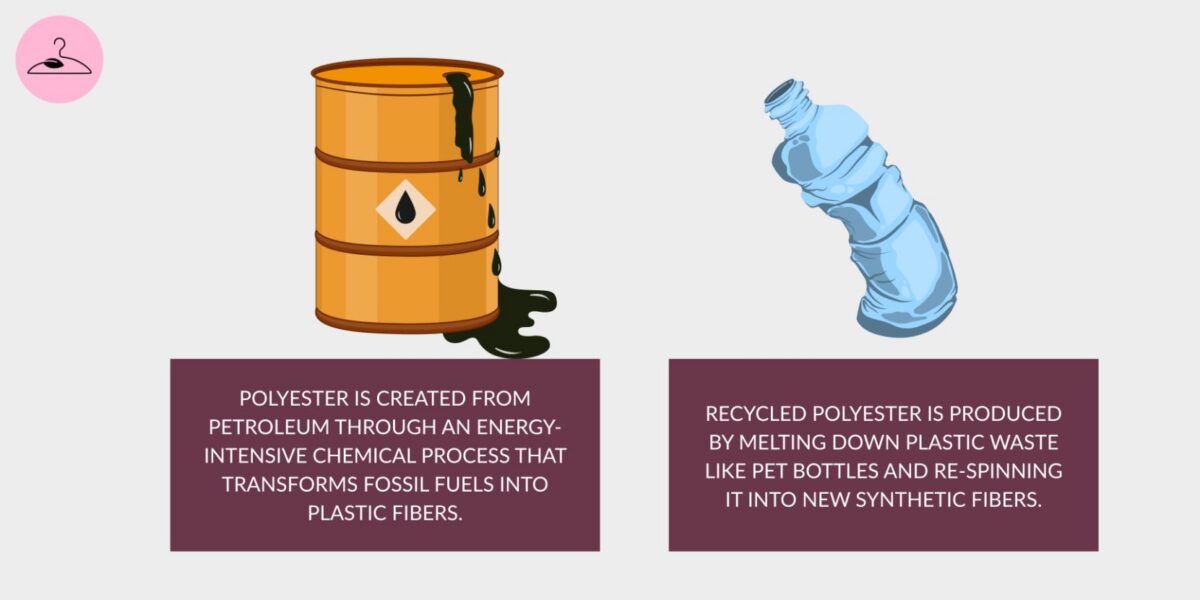
Polyester is made directly from petroleum. Crude oil is refined into PET resin, which is melted and spun into fibers. During production, the material is treated with chemicals like antimony, formaldehyde, barium sulfate, and various synthetic dyes and finishes.
The result is a fabric that’s durable but highly polluting, energy-intensive, and responsible for ongoing microplastic shedding.
Recycled Polyester (rPET)
Recycled polyester isn’t made from old clothes — it’s made from plastic bottles. These bottles are collected, washed, shredded into flakes, melted into pellets, and then spun into new fibers. Unlike virgin polyester, rPET often requires chlorine bleaching to create a uniform white base, and it may contain BPA or additional contaminants left over from the bottle industry.
Key Difference
Virgin polyester begins as petroleum, while recycled polyester begins as bottles — not textiles. And despite the sustainable marketing, both require chemical processing, both shed microplastics, and neither can be recycled back into new clothing at scale.
Chemical Concerns: Polyester vs Recycled Polyester
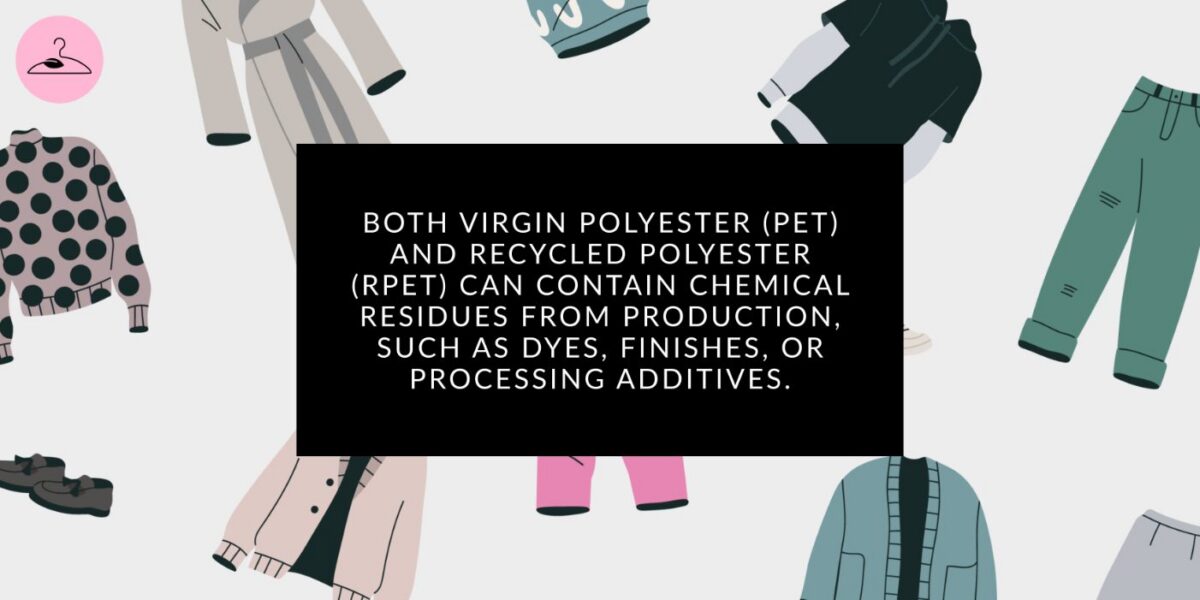
Both polyester and recycled polyester rely on heavy chemical processing — but recycled polyester can contain additional contaminants due to how it’s made. Here are the key differences based on current research and industry practices.
Antimony (Present in Both)
Both polyester and rPET contain antimony trioxide, a catalyst used to make PET resin.
Exposure is associated with nausea, vomiting, abdominal pain, skin rashes (the so-called “antimony spots”) in hot conditions, respiratory irritation, and potential cancer risks, based on animal studies.
Garment workers face the highest exposure, but trace amounts can remain in finished fabrics as well.
Chlorine Bleaching (Mostly in Recycled Polyester)
Unlike virgin polyester, rPET often requires chlorine bleaching. Why is that? Recycled plastic bottles vary in color, so manufacturers bleach the melted chips to create a uniform white base before dyeing. This process means rPET may contain:
- chlorine residues
- by-products formed during bleaching
- increased chemical load compared to standard polyester
BPA Contamination (Higher Risk in rPET)
BPA (bisphenol A) is found in many PET bottles — especially in bottles produced in Asia. When these bottles are melted down into recycled polyester, BPA can remain in the final fibers. Potential health concerns surrounding BPA are:
- endocrine disruption (xenoestrogen behavior)
- reproductive effects
- cancer risk
It’s worth noting that BPA is not exclusive to rPET — virgin polyester has tested positive in products like sports bras, socks, and athletic tops, where BPA levels exceeded safety limits by up to 31x (CEH testing). However, because rPET comes directly from bottles, the likelihood of BPA contamination is often higher.
Other Chemical Finishes (Can Appear in Both)
Virgin polyester is almost always treated with additional chemical finishes to enhance performance, appearance, or durability. These can include:
- formaldehyde (wrinkle resistance)
- barium sulfate (finishing)
- synthetic dyes
- azo dyes
- flame retardants
While these treatments are more commonly discussed in relation to virgin polyester, many of the same finishes can also appear on recycled polyester, since rPET fabrics go through the same dyeing, finishing, and processing steps once the fiber is produced.
In other words, even if recycled polyester starts with bottle waste rather than oil, the final textile is still subject to the same chemical treatments as conventional polyester — meaning the toxicity profile doesn’t necessarily improve once it becomes clothing.
Pros and Cons of Polyester vs Recycled Polyester
| Category | Polyester (Virgin PET) | Recycled Polyester (rPET) |
|---|---|---|
| Pros | • Durable and long-lasting • Cheap to produce • Easy to dye and finish • Widely available | • Uses ~59% less energy than virgin polyester • Diverts plastic bottles from landfills (temporarily) • Lower carbon footprint than virgin PET • Doesn’t rely directly on petroleum extraction |
| Cons | • Petroleum-based (non-renewable) • High carbon footprint • Sheds microplastics • Contains chemical finishes (formaldehyde, dyes, antimony) • Not recyclable at scale • Takes centuries to break down | • Still sheds microplastics • Often contains BPA + chlorine bleaching residues • Not made from old clothes (bottle-to-textile, not circular) • Also not recyclable at scale • Can divert resources from bottle recycling systems • Chemical treatment still required to finish the fabric |
Ultimately, both polyester and recycled polyester carry significant environmental drawbacks. While rPET offers lower energy use and repurposes bottle waste, it still relies on chemical processing, sheds microplastics, and cannot be recycled back into new textiles. Polyester, meanwhile, is fossil-fuel-derived and highly polluting. In practice, neither material is sustainable, and rPET’s benefits are often overstated through marketing.
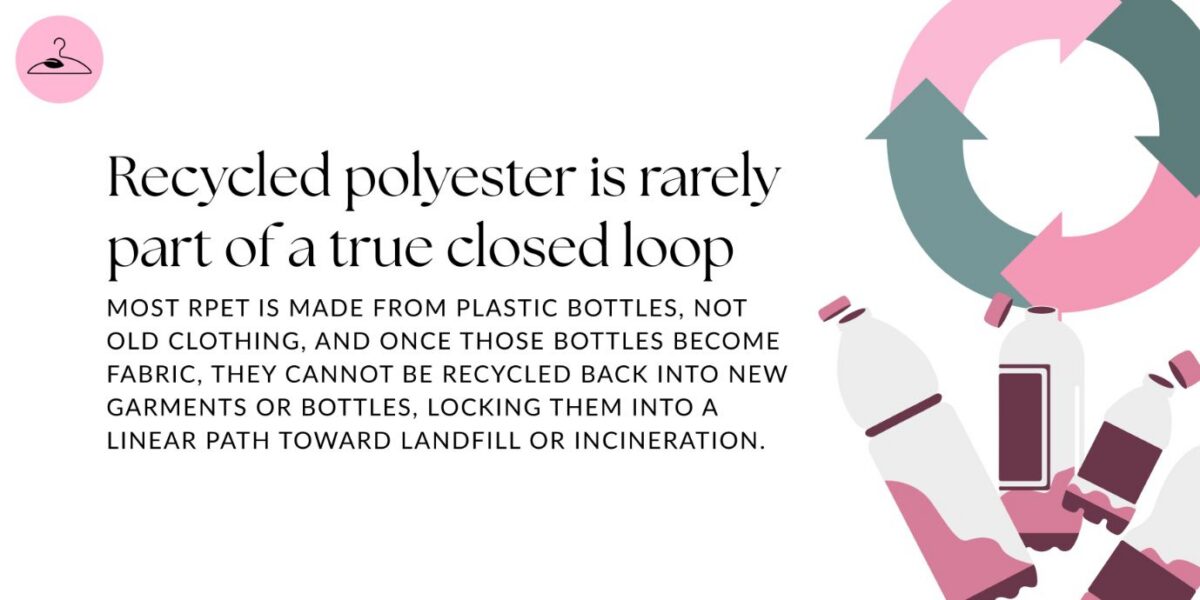
Circularity: Why Neither Polyester nor rPET Creates a Closed Loop
Circularity is one of the strongest marketing claims used to promote recycled polyester. Brands frequently present rPET as part of a “closed-loop” system — a material that can be endlessly reused and transformed. But when you examine how the fabrics actually move through the supply chain, it becomes clear that neither material is circular, and both ultimately end up as waste.
1. Recycled Polyester Comes From Bottles, Not Clothing
A truly circular textile system would turn old garments into new garments, keeping textile waste out of landfills. But recycled polyester isn’t made from discarded shirts or leggings. Instead, nearly all rPET used in fashion comes from plastic bottles and food-grade packaging.
This matters because bottles were never part of the fashion waste stream to begin with. Rather than addressing the growing volume of polyester clothing, brands draw from the bottle industry’s established recycling system and reframe it as a fashion sustainability initiative. Fast-fashion retailers such as LOFT highlight rPET as an eco-friendly upgrade, even though the material still originates from bottles — not from discarded textiles. The result is a false perception of circularity, while the underlying problem of textile waste remains largely unaddressed.
Ultimately, once those bottles are turned into rPET fabric, they can’t be recycled again — not back into bottles, and not into new clothes. That makes recycled polyester a one-way path to landfill, not a closed loop.
2. Fashion Disrupts Bottle-to-Bottle Recycling
The bottle industry, especially in regions like the EU and UK, has long invested in true circularity: collecting used bottles, processing them, and turning them back into new, food-grade bottles. This system works, and the infrastructure already exists. But fashion’s growing appetite for rPET has disrupted this circular model. Today:
- The textile industry consumes approximately 15-30% of the world’s annual rPET supply, with the majority still used in bottle and packaging production
- The bottle industry now faces increased competition for recycled PET feedstock, making it more challenging to sustain its closed-loop bottle-to-bottle recycling system
- Rising demand from textiles has caused price spikes in rPET, reducing the economic viability of bottle-to-bottle recycling
In other words, the more fashion brands claim to be “closing the loop,” the more they pull resources away from the only system that was ever circular to begin with. A bottle turned into a bottle stays in the loop. A bottle turned into a fleece jacket ends its life in a landfill. This diversion undermines broader sustainability goals and reinforces the linear nature of fashion production.
3. rPET Clothing Cannot Be Recycled Again, and Both Fabrics End Up in Landfills
Even though recycled polyester starts as a bottle, once it becomes fabric it reaches a dead end. rPET clothing is usually blended with other fibers like cotton or spandex, dyed, and treated with chemical finishes, making it nearly impossible to recycle at scale. Current textile-to-textile recycling technologies cannot efficiently separate blended fibers or remove dyes and finishes, which means most rPET garments are effectively recycling-proof.
Because of this, recycled polyester and virgin polyester share the same end-of-life outcome. Both fabrics shed microplastics, cannot be turned into new clothing, and take 70–400 years to break down in landfills. rPET may delay plastic waste temporarily, but it does not prevent it — the material still follows a linear path straight to landfill, just like regular polyester.
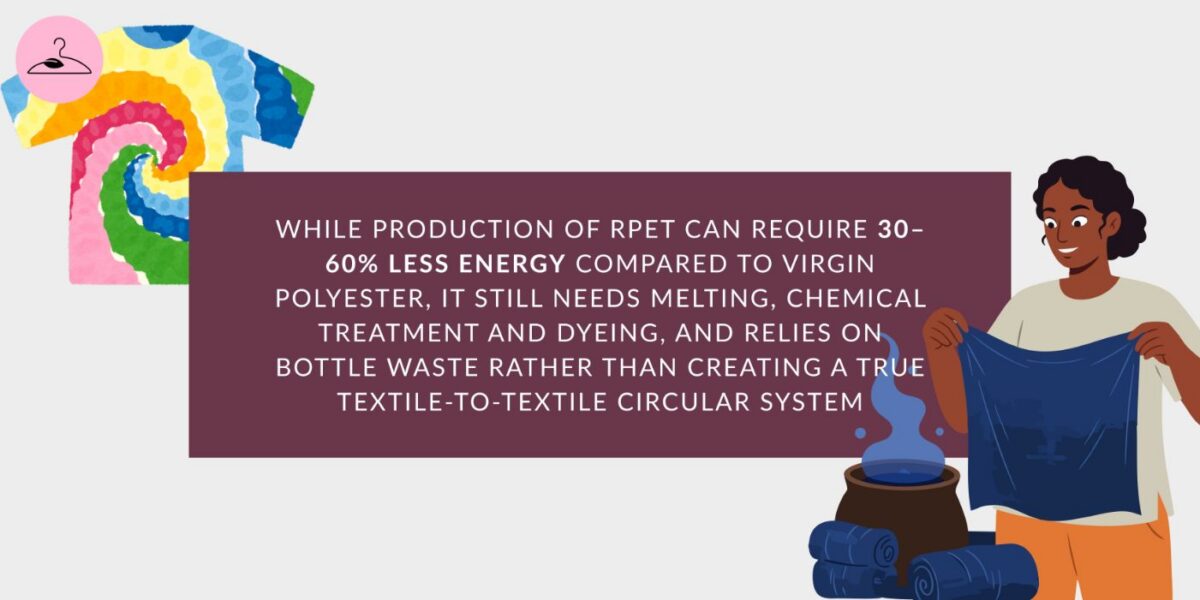
Environmental Impact: Recycled Polyester vs Virgin Polyester
Polyester and recycled polyester share many of the same environmental problems, and the differences between them are far smaller than marketing suggests.
Microplastic Pollution
Both materials shed identical amounts of microplastics during washing, wear, and disposal. These particles contaminate waterways, soil, and the air, contributing to long-term environmental harm. Because rPET is chemically the same as polyester, it does nothing to reduce microfiber pollution.
Energy & Resource Use
Recycled polyester uses less energy than virgin polyester because it avoids petroleum extraction. However, this benefit is limited. rPET still requires melting, chemical treatment, and dyeing, and it relies on bottle waste rather than creating a circular textile system.
Chemical Impact
Both fabrics involve chemicals like antimony, dyes, and finishing agents. rPET can introduce additional contaminants, including chlorine residues from bleaching and BPA from bottle-derived PET. These chemicals pose risks to workers, ecosystems, and potentially wearers.
End-of-Life Waste
Neither polyester nor rPET can be recycled into new clothing at scale. Both take 70–400 years to break down and continue shedding microplastics throughout their lifespan. Even “100% recycled polyester” garments ultimately end up in landfills.
Conclusion
When comparing polyester and recycled polyester, it becomes clear that neither material is truly sustainable. rPET uses less energy and diverts plastic bottles, but it still sheds microplastics, relies on chemical processing, and cannot be recycled into new clothing. Because it comes from bottles, not textile waste, it also fails to make fashion circular.

Frequently Asked Questions
Both materials are nearly identical in durability because rPET and virgin polyester share the same chemical structure. For outdoor gear, virgin polyester sometimes performs slightly better due to more consistent fiber quality, but the difference is minimal in everyday use. Neither fabric is biodegradable, and both shed microplastics.
Recycled polyester sheds the same amount of microplastics as virgin polyester because both materials share the exact chemical structure. rPET does not reduce microfiber pollution; both fabrics release plastic particles during washing, wear, and disposal, contributing equally to environmental microplastic contamination.
Virgin polyester has a higher carbon footprint due to petroleum extraction and energy-intensive production. Recycled polyester emits fewer greenhouse gases since it avoids the oil stage, but the reduction is relatively small. Overall, both materials maintain a high-impact lifecycle and are far from low-emission options.
You can identify recycled polyester by checking for labels that say “Recycled Polyester,” “rPET,” or “100% Recycled Polyester.” Verified certifications like GRS (Global Recycled Standard) or RCS (Recycled Claim Standard) offer stronger proof. If none are listed, the material is most likely virgin polyester.
Recycled polyester feels almost identical to virgin polyester because both fibers share the same chemical structure. rPET can sometimes feel slightly stiffer due to shorter staple fibers from bottle-derived PET, but in most garments, the difference in softness, breathability, and texture is minimal.
Sources
- Roungpaisan, N. “Effect of Recycling PET Fabric and Bottle Grade on rPET Fibers.” PubMed Central, 16 May 2023
- PET Market in Europe: State of Play 2022.” Plastics Recyclers Europe, May 2024
- Recycled Polyester Market Size, Share & Analysis, 2032.” Persistence Market Research, 10 June 2025
- Recycled Polyester Market Size to Worth USD 38.53 Billion by 2034.” GlobeNewswire, 20 Oct. 2025
- Shen, Li, et al. “Environmental Sustainability Assessment of a Polyester T-Shirt.” Science of The Total Environment, vol. 856, 2023
- Napper, Imogen E., et al. “Study on the Relationship between Textile Microplastics Shedding and Fabric Characteristics.” Environmental Science & Technology, vol. 56, no. 1, 2022, pp. 383-392
- Harris, Steven. “How Does Recycled Polyester Affect the Environment?” Sustainability Directory, 7 Mar. 2025
- O’Connell, Stephen. “Polyester Recycling: Chemical Risks & Safe Solutions.” Bluesign, 10 Sept. 2025